



Orchid Pollination By Insect – Spring-Like Mechanism in Catasetum Orchid Genus
Author: admin1 Comment
Blooming, Care and Culture, Classification, Propagation
Perhaps the genus Catasetum is the most ingenious method of ensuring pollination.
There are two sections in the genus, one of which has perfect flowers, i.e. male and female reproductive organs in the same flower (or hermaphroditic flowers like most other orchids) and the other, the Orthocatasetum, has male flowers and female flowers, often on the same plant, and very rarely hermaphroditic flowers. A bee settles on the labellum of a male flower on which there is no nectar but part of the labellum has an enticing taste (to a bee) and so he gnaws it. There are two very sensitive antennae with their ends projecting and the bee touches one of these (in C. saccatum, the left one) and the pollen is ejected by means of a spring-like pedicel attached to the pollinia. It strikes the bee with considerable force and becomes attached to the thorax because it is sticky. On visiting another flower, a female, the pollen is removed and the female flower is fertilized.
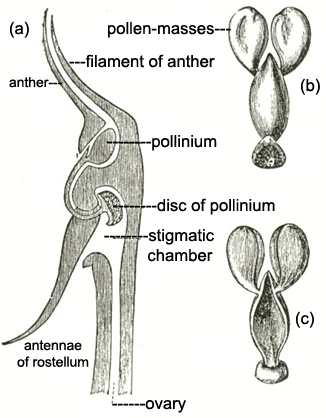
Catasetum saccatum: flower structure. (a)Diagrammatic section through the column with all the parts a little separated. (b)Pollination, upper surface. (c)Pollinium, lower surface, which before removal lies in close contact with the rostellum.
If you enjoyed this, please share it!


One response on “Orchid Pollination By Insect – Spring-Like Mechanism in Catasetum Orchid Genus”
Leave a Reply

Ask an Expert
Questions about orchids?
Our experts love a challenge!
Busono
Oncidium
Photo of the Week
Submit your photo to be featured on the blog!
More Photo of the Week Winners
Submit Photo
Well done in describing the technical procedure of pollination, but unfortunately no precise precription of the species of bees, promoting the technical act of pollination; sorry, but this of important interest to me, researching “Pollinators of Orchids”.
Kind regards,
Wolfgang E. Melenk