



Orchids Classification Overview
Author: admin8 Comments
Orchid Plant Family Classification Overview by OrchidPlantCare.info
About 140 species of orchid are native to North America, usually as bog plants or flowers of moist woodlands and meadows. The orchid family is classified in the division Magnoliophyta, class Liliopsida, order Orchidales. The family of monocotyledonous plants has evolved from prototypes of the lily and amaryllis family and is noteworthy for the wide variety of its highly specialized and curiously modified forms. Epiphytic types have a stem swollen at the base to form a pseudobulb (for food storage) and pendulous aerial roots adapted for water absorption and sometimes containing chlorophyll to make photosynthesis possible. In terrestrial types a symbiotic relationship often exists between the roots and filamentous fungi (mycorrhiza). Horticulturists have found that the presence of certain fungi is necessary for the germination of the minute seeds. Orchid pollen occurs as mealy or waxen lumps of tiny pollen grains, highly varied in form.
The flowers characteristically consist of three petals and three petallike sepals, the central sepal modified into a conspicuous lip (labellum) specialized to secrete nectar that attracts insects. Most of the diverse forms of orchid flowers are apparently complicated adaptations for pollination by specific insects, e.g., the enormous waxflower of Africa, which has a labellum over a foot long and is pollinated by a moth with a tongue of equal length. The saclike labellum of the lady’s-slipper serves the same function by forcing the insect to brush against the anther and the stigma (male and female organs) while procuring nectar.
Orchid Species
The expensive orchid of the florists’ trade is usually the large cattleya; species of this genus (Cattleya) are epiphytic plants native to tropical America. Among the other cultivated orchids are several of the terrestrial rein orchids (genus Habenaria) and many epiphytic tropical genera, e.g., the Asian Dendrobium, with pendant clusters of flowers; Epidendrum, represented in the SE United States by the greenfly orchid; and Odontoglossum, indigenous to the Andes Mountains.
Species of lady’s-slipper, or moccasin flower (Cypripedium) [Lat.,=slipper of Venus], include the pink-blossomed common, or stemless, lady’s-slipper (C. acaule) and the showy lady’s-slipper (C. reginae), both of the Northeast, and varieties of the yellow lady’s-slipper (C. calceolus), which grow in all but the warmest regions of the continent. Other terrestrial genera that grow as American wildflowers are the fringe orchids (Blephariglottis); the small-blossomed twayblades (species of Liparis and Listera); the pogonias, or beard-flowers (Pogonia); the wild pinks, or swamp rose orchids (Arethusa), of northeastern sphagnum bogs; the grass pinks (Limodorum) of eastern bogs and meadows; and the ladies’-tresses, or pearl-twists (Spiranthes), with a distinctive spiral arrangement of yellowish or white flowers. The coral-roots (Corallorhiza), named for the corallike branching of their underground rhizomes, are a nongreen saprophytic genus which includes some North American species. Because orchids are characteristically slow growing and difficult to seed, excessive picking and futile attempts to transplant have depleted native species in some areas.
Commonly Cultivated Orchid Plants
Many orchid plant species have become tremendously popular over the years for two main reasons: Their beautiful showy blooms and the ease of care required.
- Cattleyas
- Phalaenopsis
- Paphiopedilums
- Cymbidiums
- Dendrobiums
- Oncidiums
- Vandas
If you enjoyed this, please share it!


8 Responses to “Orchids Classification Overview”
Leave a Reply


Ask an Expert
Questions about orchids?
Our experts love a challenge!
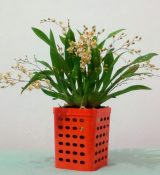
Busono
Oncidium
Photo of the Week
Submit your photo to be featured on the blog!
More Photo of the Week Winners
Submit Photo
I received an orchid plant for my birthday in January. It has very thick green leaves. The orchid has two thin wood stalks. On it were purple/pink flowers.. The flowers have fallen off and I don’t know if this is normal. I did not receive any care instructions with the plant but there was a plant stake that had the numbers NW05-45 P. Brother Sara Gold. I cannot find this orchid plant on google. Can you help me out with the care of this orchid?
Thank you.
C. Mossman
@ C. Mossman. The orchid that you are referring to is called a Phalaenopsis Brother Sara Gold orchid. I’m guessing that NW0545 must be some sort of serial number indicating where the plant came from. Luckily for you this particular orchid is ideal for beginner growers.
Here’s more on growing Phalaenopsis Brother Sara Gold Orchids
Have fun growing!
I just purchased 2 Orchids and don’t know how to take care of them. Do they require sunlight, and how much do you water them?
@ Len Rothstein. Do you have any idea what kind of orchids you’ve purchased? There is constantly new research being developed for species specific growing guidelines. The following tips are not orchid plant specific, but more general.
Here is my Orchid Plant Care Overview, I hope it provides you with some useful tips on how to help your orchid plants flourish!
Where i can get moon orchid? this flower is really nice.
A girl in my office rec’d an orchid for Valentine’s Day… the thick green leaves at the bottom still look great, but the stem that supported the flower and the bloom itself are now brown and sad. I’m guessing this needs to be removed and it will bloom again when the time comes… however everyone is afraid to remove the stem since her husband paid a decent amount for this plant. 🙂 The stick in the soil reads… Paph. (Makuli-curtisii) – Maudiae X – Paph. Maudiae- ‘Napa Valley’ HCC/AOS
Any care info is appreciated.
I am certainly an ameteur orchid grower but have been growing them in my house and outside for about 13 years. i think i have it fairly well down but am baffled by some things that have occurred in the last few years. i have brought some of my orchids from Puerto Rico and Miami where we once lived. I am now in the upstate of SC. my climate has certainly changed but things are going well- we’ve been here for 4 years now. here’s my question. Qts #1 i have what i have always called a brassovola nodosa. it is unsual looking with extremely fragrant white slender blooms. it only smells at night. last year after a very prufuse blooming, about 95% of the plant died. i have had this plant for at least 10 years. i was able to salvage part of it but what is going on and what do i need to do? a similiar thing happenned two years ago to my brassovola mai kai(that the name i was told in PR). QTS #2- i have several phals that have begun to produce plants off their spikes every year. these mother plants are beautiful and healthy. i divided them so that this process might stop, but it seems it just keeps creating new plants on top of the old plant or off one of the spikes. it will also put out at least three other flowering spikes at the same time. why does it do this, and what do i need to do? should i do something to stop this process? QTS #3 since moving to SC my superbum, when it looses its leaves, only looses a portion of its leaves. this prohibs the plan to bloom to its fullest since it doesn’t loose all its leaves. what can i do to force it to loose the rest of them and, better yet, what am i doing to make the leaves stop falling? the plant is plenty long and so so healthy. i love this orchid but it needs to loose all it’s leaves to be showy. and last- QTS #4- i divided my oncidiums this summer. now half the plant blooms when it used to(in the fall) and the half of it is throwing out spikes now. why? this wouldn’t be such a big deal except that this is occurring within the pot. so half the pot already bloomed and the other half will in the next few months. what did i do and can i correct it?
thanks so much for anyones time- i need some expecienced help here!
sincerely, tami
Are there an species of orchids that live in water, like a lake, river, or Ocean? I keep seeing that they live almost anywhere, but can not find information about orchids in water. Please help.